NEOCONTEXTAI
NeoContext is my latest project in Artificial Intelligence. The goal is to combine evolution with reinforcement learning
and an appropriate training set to create models capable of general reasoning. I am currently working with Hierarchical Temporal Memory,
a brain-based AI architecture that mimics the neocortex, to explore this area. This web page is in its very early stages, and will be updated as I develop the project further.
Update 11/15/25: Have successfully implemented the ClassifierRegion, am able to feed tokens to our model. Now, need to map integer values back to tokens for readibility, and greatly expand our dataset, implement a stop token, and begin evolution architecture.
Update 12/21/25
We have removed the built-in HTM ClassifierRegion and substituted with a custom classifier- this way we can train the classifier and use the same classifier to infer the current predicted cells.
The most recent development has been demonstrating, using HTM.core's anomaly detection, that the network is capable of learning the sequences it is fed! The challenge here is ensuring that the low anomaly isn't due to
the HTM circuits predictingall possible next inputs, but that it is truly learning the proper next token when fed a string of text.
To train the model, sentences of the following format are used: "X is at Y. Z is at W. Where is X?" to test the ability of HTM to extrapolate symbolic and logical formulas from text training examples. Since X, Y, Z, and W can be anything, a successful model needs to learn to focus on the "is at" and "Where is" parts of these sentences, while learning that the answer is simply X. Figuring out how to do this has been rather complicated, with some mixed successes on the way.
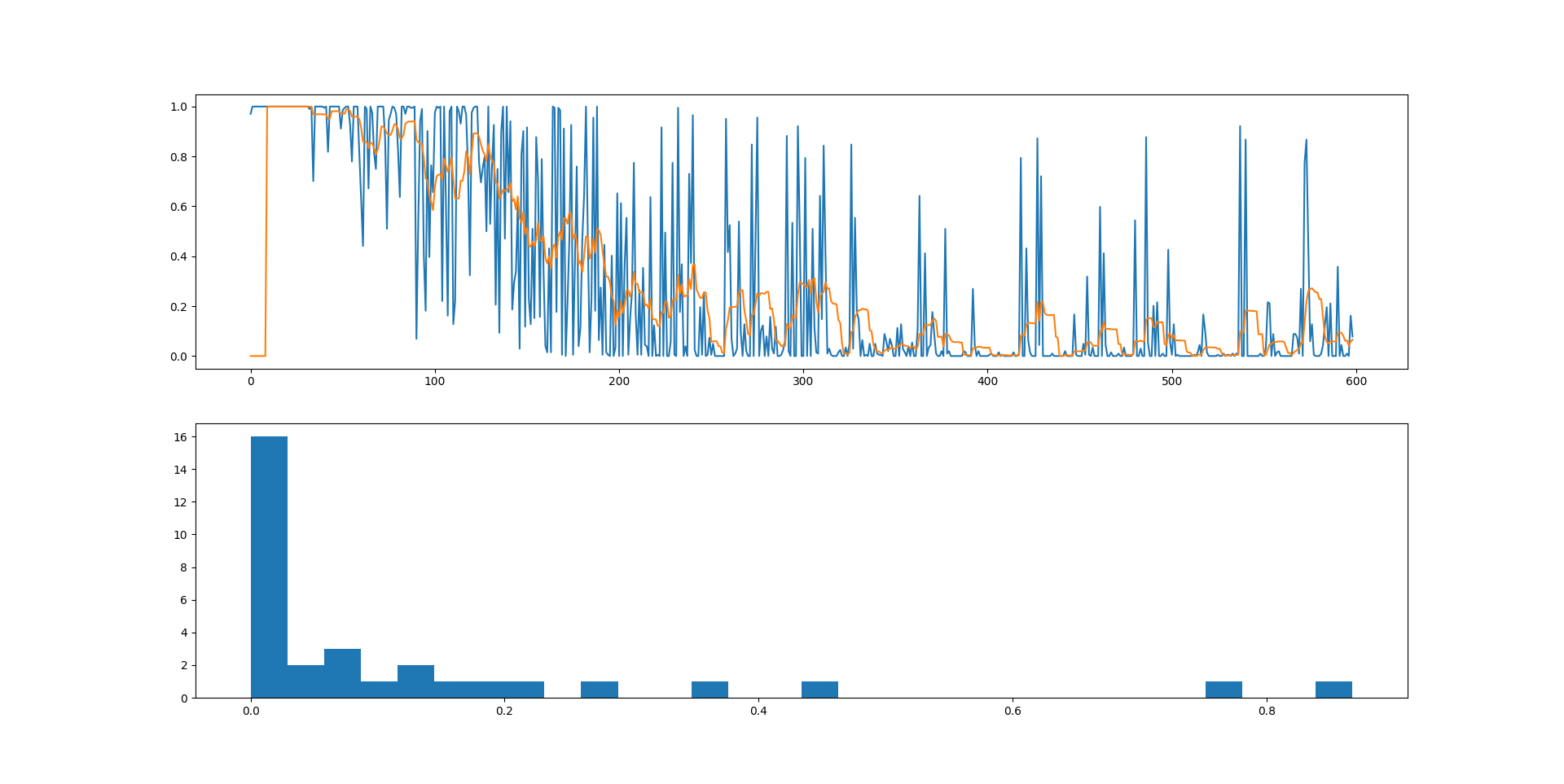
An early test of the ability of a one-layer HTM network to learn text sequences of the above form. Later analysis would suggest that the model's prediction radius grew so wide it was effectively predicting all of the possible next tokens, so while it technically was learning the sequences, it wasn't learning them in a way to successfully understand the testing examples in a productive manner. The lower the graph goes, the lower the anomaly, which means the more the model understands the input sequence. Here, there is an overwhelming number of training examples with a low anomaly, as seen in the histogram.
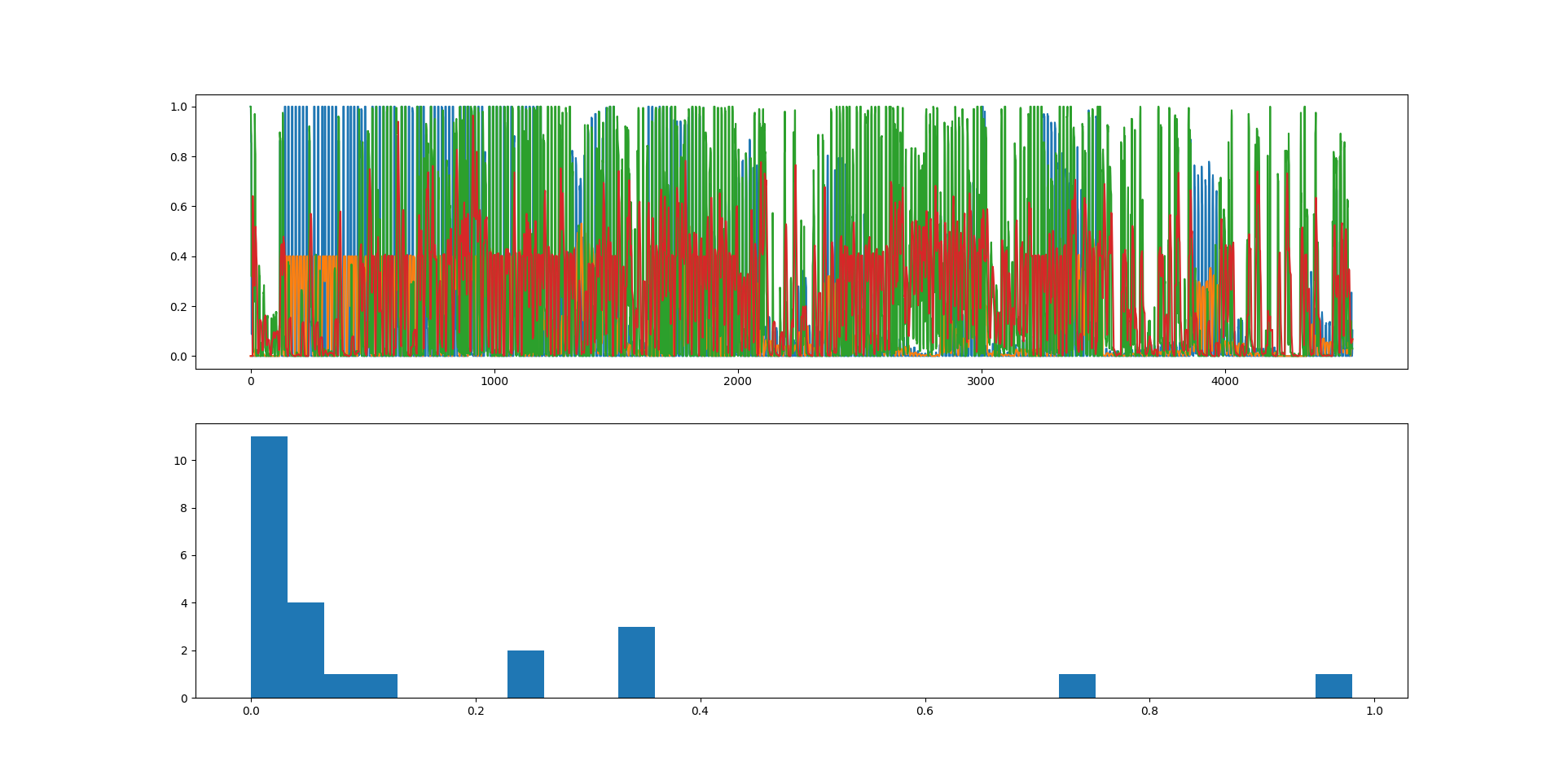
Next, I tested my theory of mimicking persistent firing among lower layers of the neocortical hierarchy to relay higher-level information to a second layer. The anomaly score of the second layer may be seen in red, demonstrating that this technique did successfully teach the second layer of the HTM network to understand textual input as a "moving window" of multiple words at once, with the goal of using this persistence of information to go beyond single-token understanding and build broader, higher-level understandings of what is going on, on a slower temporal timescale. The idea is that by offering higher levels of the HTM network spatial representations of temporal sequences, these higher levels can consolidate information across time to form symbolic understandings of text, in the same way that humans use their working memory to maintain words and ideas that have been recently processed in order to form understandings. If the human mind were limited to comprehending one idea or one word at a time, it wouldn't be able to form hierarchical understandings of multiple words or ideas through the indespensible power of context. This idea of multiple-token context is the very concept behind the attention mechanism in transformers.